Examples
Real input, real output. Every diagram on this page was drawn by SchemaDrawer from the files shown next to it.
PetClinic in three Flyway migrations
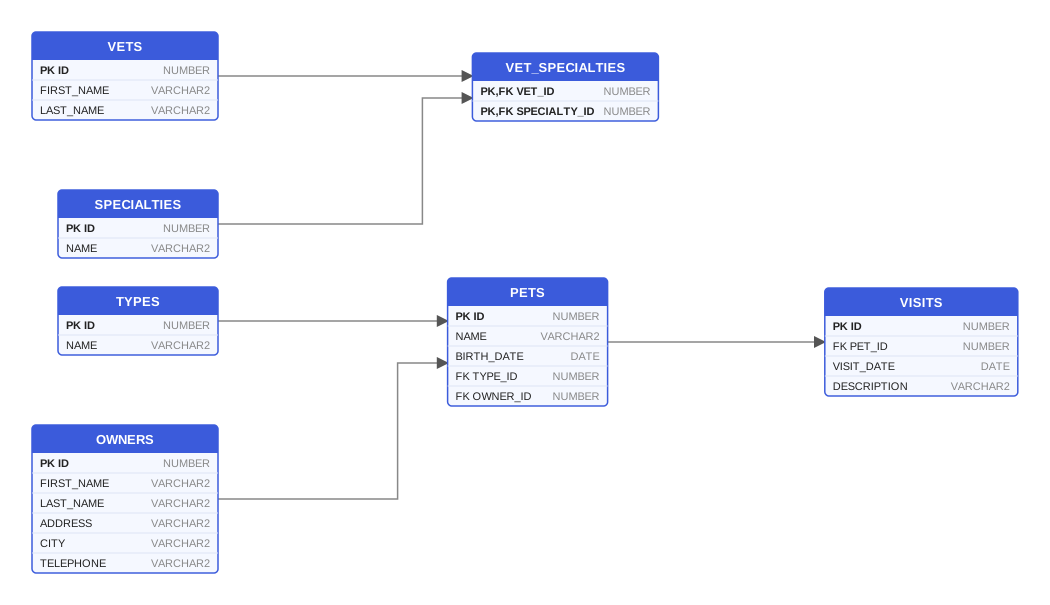
Seven tables: owners have pets of a type, vets have specialties through a join table, pets have visits. Drawn on PostgreSQL 18.
CREATE TABLE owners
(
    id         INT          NOT NULL,
    first_name VARCHAR(50)  NOT NULL,
    last_name  VARCHAR(50)  NOT NULL,
    address    VARCHAR(255),
    city       VARCHAR(80),
    telephone  VARCHAR(20),
    CONSTRAINT pk_owners PRIMARY KEY (id)
);

CREATE TABLE types
(
    id   INT         NOT NULL,
    name VARCHAR(80) NOT NULL,
    CONSTRAINT pk_types PRIMARY KEY (id)
);

CREATE TABLE pets
(
    id         INT         NOT NULL,
    name       VARCHAR(50) NOT NULL,
    birth_date DATE,
    type_id    INT         NOT NULL,
    owner_id   INT         NOT NULL,
    CONSTRAINT pk_pets PRIMARY KEY (id),
    CONSTRAINT fk_pets_types FOREIGN KEY (type_id) REFERENCES types (id),
    CONSTRAINT fk_pets_owners FOREIGN KEY (owner_id) REFERENCES owners (id)
);
CREATE TABLE vets
(
    id         INT         NOT NULL,
    first_name VARCHAR(50) NOT NULL,
    last_name  VARCHAR(50) NOT NULL,
    CONSTRAINT pk_vets PRIMARY KEY (id)
);

CREATE TABLE specialties
(
    id   INT         NOT NULL,
    name VARCHAR(80) NOT NULL,
    CONSTRAINT pk_specialties PRIMARY KEY (id)
);

CREATE TABLE vet_specialties
(
    vet_id       INT NOT NULL,
    specialty_id INT NOT NULL,
    CONSTRAINT pk_vet_specialties PRIMARY KEY (vet_id, specialty_id),
    CONSTRAINT fk_vet_specialties_vets FOREIGN KEY (vet_id) REFERENCES vets (id),
    CONSTRAINT fk_vet_specialties_specialties FOREIGN KEY (specialty_id) REFERENCES specialties (id)
);
CREATE TABLE visits
(
    id          INT NOT NULL,
    pet_id      INT NOT NULL,
    visit_date  DATE,
    description VARCHAR(255),
    CONSTRAINT pk_visits PRIMARY KEY (id),
    CONSTRAINT fk_visits_pets FOREIGN KEY (pet_id) REFERENCES pets (id)
);
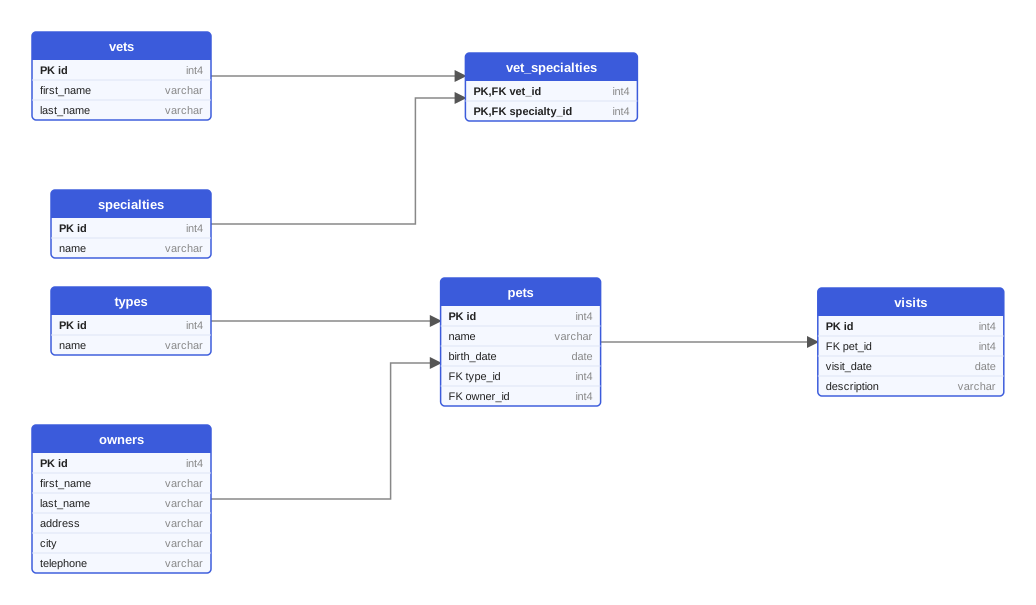
Primary keys in bold with PK; foreign keys marked FK, each drawn as an arrow from the referenced table to the referencing one and labelled with the column. vet_specialties has a composite primary key made of two foreign keys. Open the SVG.
The same schema in ten other tools
SchemaDrawer's test suite keeps the PetClinic schema written for every supported tool. Whatever the input language, the diagram is the one above.
<?xml version="1.0" encoding="UTF-8"?>
<databaseChangeLog xmlns="http://www.liquibase.org/xml/ns/dbchangelog"
                   xmlns:xsi="http://www.w3.org/2001/XMLSchema-instance"
                   xsi:schemaLocation="http://www.liquibase.org/xml/ns/dbchangelog
                                       http://www.liquibase.org/xml/ns/dbchangelog/dbchangelog-latest.xsd">

    <changeSet id="001-owners" author="schemadrawer">
        <createTable tableName="owners">
            <column name="id" type="INT">
                <constraints primaryKey="true" primaryKeyName="pk_owners" nullable="false"/>
            </column>
            <column name="first_name" type="VARCHAR(50)">
                <constraints nullable="false"/>
            </column>
            <column name="last_name" type="VARCHAR(50)">
                <constraints nullable="false"/>
            </column>
            <column name="address" type="VARCHAR(255)"/>
            <column name="city" type="VARCHAR(80)"/>
            <column name="telephone" type="VARCHAR(20)"/>
        </createTable>
    </changeSet>

    <changeSet id="001-types" author="schemadrawer">
        <createTable tableName="types">
            <column name="id" type="INT">
                <constraints primaryKey="true" primaryKeyName="pk_types" nullable="false"/>
            </column>
            <column name="name" type="VARCHAR(80)">
                <constraints nullable="false"/>
            </column>
        </createTable>
    </changeSet>

    <changeSet id="001-pets" author="schemadrawer">
        <createTable tableName="pets">
            <column name="id" type="INT">
                <constraints primaryKey="true" primaryKeyName="pk_pets" nullable="false"/>
            </column>
            <column name="name" type="VARCHAR(50)">
                <constraints nullable="false"/>
            </column>
            <column name="birth_date" type="DATE"/>
            <column name="type_id" type="INT">
                <constraints nullable="false"
                             foreignKeyName="fk_pets_types"
                             references="types(id)"/>
            </column>
            <column name="owner_id" type="INT">
                <constraints nullable="false"
                             foreignKeyName="fk_pets_owners"
                             references="owners(id)"/>
            </column>
        </createTable>
    </changeSet>

</databaseChangeLog>
<?xml version="1.0" encoding="UTF-8"?>
<databaseChangeLog xmlns="http://www.liquibase.org/xml/ns/dbchangelog"
                   xmlns:xsi="http://www.w3.org/2001/XMLSchema-instance"
                   xsi:schemaLocation="http://www.liquibase.org/xml/ns/dbchangelog
                                       http://www.liquibase.org/xml/ns/dbchangelog/dbchangelog-latest.xsd">

    <changeSet id="002-vets" author="schemadrawer">
        <createTable tableName="vets">
            <column name="id" type="INT">
                <constraints primaryKey="true" primaryKeyName="pk_vets" nullable="false"/>
            </column>
            <column name="first_name" type="VARCHAR(50)">
                <constraints nullable="false"/>
            </column>
            <column name="last_name" type="VARCHAR(50)">
                <constraints nullable="false"/>
            </column>
        </createTable>
    </changeSet>

    <changeSet id="002-specialties" author="schemadrawer">
        <createTable tableName="specialties">
            <column name="id" type="INT">
                <constraints primaryKey="true" primaryKeyName="pk_specialties" nullable="false"/>
            </column>
            <column name="name" type="VARCHAR(80)">
                <constraints nullable="false"/>
            </column>
        </createTable>
    </changeSet>

    <changeSet id="002-vet-specialties" author="schemadrawer">
        <createTable tableName="vet_specialties">
            <!--
                The composite key is declared here rather than added afterwards: SQLite cannot add a
                primary key to a table that already exists, and Liquibase refuses addPrimaryKey
                there outright. Naming both columns inside createTable makes one composite key, and
                every engine takes it.
            -->
            <column name="vet_id" type="INT">
                <constraints nullable="false"
                             primaryKey="true"
                             primaryKeyName="pk_vet_specialties"
                             foreignKeyName="fk_vet_specialties_vets"
                             references="vets(id)"/>
            </column>
            <column name="specialty_id" type="INT">
                <constraints nullable="false"
                             primaryKey="true"
                             primaryKeyName="pk_vet_specialties"
                             foreignKeyName="fk_vet_specialties_specialties"
                             references="specialties(id)"/>
            </column>
        </createTable>
    </changeSet>

</databaseChangeLog>
<?xml version="1.0" encoding="UTF-8"?>
<databaseChangeLog xmlns="http://www.liquibase.org/xml/ns/dbchangelog"
                   xmlns:xsi="http://www.w3.org/2001/XMLSchema-instance"
                   xsi:schemaLocation="http://www.liquibase.org/xml/ns/dbchangelog
                                       http://www.liquibase.org/xml/ns/dbchangelog/dbchangelog-latest.xsd">

    <changeSet id="003-visits" author="schemadrawer">
        <createTable tableName="visits">
            <column name="id" type="INT">
                <constraints primaryKey="true" primaryKeyName="pk_visits" nullable="false"/>
            </column>
            <column name="pet_id" type="INT">
                <constraints nullable="false"
                             foreignKeyName="fk_visits_pets"
                             references="pets(id)"/>
            </column>
            <column name="visit_date" type="DATE"/>
            <column name="description" type="VARCHAR(255)"/>
        </createTable>
    </changeSet>

</databaseChangeLog>
<?xml version="1.0" encoding="UTF-8"?>
<databaseChangeLog xmlns="http://www.liquibase.org/xml/ns/dbchangelog"
                   xmlns:xsi="http://www.w3.org/2001/XMLSchema-instance"
                   xsi:schemaLocation="http://www.liquibase.org/xml/ns/dbchangelog
                                       http://www.liquibase.org/xml/ns/dbchangelog/dbchangelog-latest.xsd">

    <include file="changes/001-owners-and-pets.xml" relativeToChangelogFile="true"/>
    <include file="changes/002-vets.xml" relativeToChangelogFile="true"/>
    <include file="changes/003-visits.xml" relativeToChangelogFile="true"/>

</databaseChangeLog>
CREATE TABLE owners
(
    id         INT          NOT NULL,
    first_name VARCHAR(50)  NOT NULL,
    last_name  VARCHAR(50)  NOT NULL,
    address    VARCHAR(255),
    city       VARCHAR(80),
    telephone  VARCHAR(20),
    CONSTRAINT pk_owners PRIMARY KEY (id)
);

CREATE TABLE types
(
    id   INT         NOT NULL,
    name VARCHAR(80) NOT NULL,
    CONSTRAINT pk_types PRIMARY KEY (id)
);

CREATE TABLE pets
(
    id         INT         NOT NULL,
    name       VARCHAR(50) NOT NULL,
    birth_date DATE,
    type_id    INT         NOT NULL,
    owner_id   INT         NOT NULL,
    CONSTRAINT pk_pets PRIMARY KEY (id),
    CONSTRAINT fk_pets_types FOREIGN KEY (type_id) REFERENCES types (id),
    CONSTRAINT fk_pets_owners FOREIGN KEY (owner_id) REFERENCES owners (id)
);
CREATE TABLE vets
(
    id         INT         NOT NULL,
    first_name VARCHAR(50) NOT NULL,
    last_name  VARCHAR(50) NOT NULL,
    CONSTRAINT pk_vets PRIMARY KEY (id)
);

CREATE TABLE specialties
(
    id   INT         NOT NULL,
    name VARCHAR(80) NOT NULL,
    CONSTRAINT pk_specialties PRIMARY KEY (id)
);

CREATE TABLE vet_specialties
(
    vet_id       INT NOT NULL,
    specialty_id INT NOT NULL,
    CONSTRAINT pk_vet_specialties PRIMARY KEY (vet_id, specialty_id),
    CONSTRAINT fk_vet_specialties_vets FOREIGN KEY (vet_id) REFERENCES vets (id),
    CONSTRAINT fk_vet_specialties_specialties FOREIGN KEY (specialty_id) REFERENCES specialties (id)
);
CREATE TABLE visits
(
    id          INT NOT NULL,
    pet_id      INT NOT NULL,
    visit_date  DATE,
    description VARCHAR(255),
    CONSTRAINT pk_visits PRIMARY KEY (id),
    CONSTRAINT fk_visits_pets FOREIGN KEY (pet_id) REFERENCES pets (id)
);
from django.db import migrations, models
import django.db.models.deletion


class Migration(migrations.Migration):

    initial = True

    dependencies = []

    operations = [
        migrations.CreateModel(
            name="Owner",
            fields=[
                ("id", models.IntegerField(primary_key=True, serialize=False)),
                ("first_name", models.CharField(max_length=50)),
                ("last_name", models.CharField(max_length=50)),
                ("address", models.CharField(max_length=255, null=True)),
                ("city", models.CharField(max_length=80, null=True)),
                ("telephone", models.CharField(max_length=20, null=True)),
            ],
            options={
                "db_table": "owners",
            },
        ),
        migrations.CreateModel(
            name="Type",
            fields=[
                ("id", models.IntegerField(primary_key=True, serialize=False)),
                ("name", models.CharField(max_length=80)),
            ],
            options={
                "db_table": "types",
            },
        ),
        migrations.CreateModel(
            name="Pet",
            fields=[
                ("id", models.IntegerField(primary_key=True, serialize=False)),
                ("name", models.CharField(max_length=50)),
                ("birth_date", models.DateField(null=True)),
                (
                    "type",
                    models.ForeignKey(
                        db_column="type_id",
                        on_delete=django.db.models.deletion.DO_NOTHING,
                        to="petclinic.type",
                    ),
                ),
                (
                    "owner",
                    models.ForeignKey(
                        db_column="owner_id",
                        on_delete=django.db.models.deletion.DO_NOTHING,
                        to="petclinic.owner",
                    ),
                ),
            ],
            options={
                "db_table": "pets",
            },
        ),
    ]
from django.db import migrations, models
import django.db.models.deletion


class Migration(migrations.Migration):

    dependencies = [
        ("petclinic", "0001_owners_types_pets"),
    ]

    operations = [
        migrations.CreateModel(
            name="Vet",
            fields=[
                ("id", models.IntegerField(primary_key=True, serialize=False)),
                ("first_name", models.CharField(max_length=50)),
                ("last_name", models.CharField(max_length=50)),
            ],
            options={
                "db_table": "vets",
            },
        ),
        migrations.CreateModel(
            name="Specialty",
            fields=[
                ("id", models.IntegerField(primary_key=True, serialize=False)),
                ("name", models.CharField(max_length=80)),
            ],
            options={
                "db_table": "specialties",
            },
        ),
        migrations.CreateModel(
            name="VetSpecialty",
            fields=[
                ("pk", models.CompositePrimaryKey("vet", "specialty")),
                (
                    "vet",
                    models.ForeignKey(
                        db_column="vet_id",
                        on_delete=django.db.models.deletion.DO_NOTHING,
                        to="petclinic.vet",
                    ),
                ),
                (
                    "specialty",
                    models.ForeignKey(
                        db_column="specialty_id",
                        on_delete=django.db.models.deletion.DO_NOTHING,
                        to="petclinic.specialty",
                    ),
                ),
            ],
            options={
                "db_table": "vet_specialties",
            },
        ),
    ]
from django.db import migrations, models
import django.db.models.deletion


class Migration(migrations.Migration):

    dependencies = [
        ("petclinic", "0002_vets_specialties"),
    ]

    operations = [
        migrations.CreateModel(
            name="Visit",
            fields=[
                ("id", models.IntegerField(primary_key=True, serialize=False)),
                (
                    "pet",
                    models.ForeignKey(
                        db_column="pet_id",
                        on_delete=django.db.models.deletion.DO_NOTHING,
                        to="petclinic.pet",
                    ),
                ),
                ("visit_date", models.DateField(null=True)),
                ("description", models.CharField(max_length=255, null=True)),
            ],
            options={
                "db_table": "visits",
            },
        ),
    ]
using Microsoft.EntityFrameworkCore.Migrations;

#nullable disable

namespace Clinic.Migrations;

/// <summary>
/// Hand-written in EF Core's own migration shape. The id is given by the [Migration] attribute
/// and repeated in the file name, which is the convention `dotnet ef migrations add` follows.
/// No column is given an explicit `type:` string, so each provider maps the CLR type itself and
/// the one file produces the same schema on PostgreSQL and on MySQL.
/// </summary>
[Migration("20240101120000_CreateOwnersAndPets")]
public partial class CreateOwnersAndPets : Migration
{
    protected override void Up(MigrationBuilder migrationBuilder)
    {
        migrationBuilder.CreateTable(
            name: "owners",
            columns: table => new
            {
                id = table.Column<int>(nullable: false),
                first_name = table.Column<string>(maxLength: 50, nullable: false),
                last_name = table.Column<string>(maxLength: 50, nullable: false),
                address = table.Column<string>(maxLength: 255, nullable: true),
                city = table.Column<string>(maxLength: 80, nullable: true),
                telephone = table.Column<string>(maxLength: 20, nullable: true)
            },
            constraints: table =>
            {
                table.PrimaryKey("pk_owners", x => x.id);
            });

        migrationBuilder.CreateTable(
            name: "types",
            columns: table => new
            {
                id = table.Column<int>(nullable: false),
                name = table.Column<string>(maxLength: 80, nullable: false)
            },
            constraints: table =>
            {
                table.PrimaryKey("pk_types", x => x.id);
            });

        migrationBuilder.CreateTable(
            name: "pets",
            columns: table => new
            {
                id = table.Column<int>(nullable: false),
                name = table.Column<string>(maxLength: 50, nullable: false),
                birth_date = table.Column<DateOnly>(nullable: true),
                type_id = table.Column<int>(nullable: false),
                owner_id = table.Column<int>(nullable: false)
            },
            constraints: table =>
            {
                table.PrimaryKey("pk_pets", x => x.id);
                table.ForeignKey(
                    name: "fk_pets_types",
                    column: x => x.type_id,
                    principalTable: "types",
                    principalColumn: "id");
                table.ForeignKey(
                    name: "fk_pets_owners",
                    column: x => x.owner_id,
                    principalTable: "owners",
                    principalColumn: "id");
            });
    }

    protected override void Down(MigrationBuilder migrationBuilder)
    {
        migrationBuilder.DropTable(name: "pets");
        migrationBuilder.DropTable(name: "types");
        migrationBuilder.DropTable(name: "owners");
    }
}
using Microsoft.EntityFrameworkCore.Migrations;

#nullable disable

namespace Clinic.Migrations;

[Migration("20240202120000_CreateVets")]
public partial class CreateVets : Migration
{
    protected override void Up(MigrationBuilder migrationBuilder)
    {
        migrationBuilder.CreateTable(
            name: "vets",
            columns: table => new
            {
                id = table.Column<int>(nullable: false),
                first_name = table.Column<string>(maxLength: 50, nullable: false),
                last_name = table.Column<string>(maxLength: 50, nullable: false)
            },
            constraints: table =>
            {
                table.PrimaryKey("pk_vets", x => x.id);
            });

        migrationBuilder.CreateTable(
            name: "specialties",
            columns: table => new
            {
                id = table.Column<int>(nullable: false),
                name = table.Column<string>(maxLength: 80, nullable: false)
            },
            constraints: table =>
            {
                table.PrimaryKey("pk_specialties", x => x.id);
            });

        // The composite primary key.
        migrationBuilder.CreateTable(
            name: "vet_specialties",
            columns: table => new
            {
                vet_id = table.Column<int>(nullable: false),
                specialty_id = table.Column<int>(nullable: false)
            },
            constraints: table =>
            {
                table.PrimaryKey("pk_vet_specialties", x => new { x.vet_id, x.specialty_id });
                table.ForeignKey(
                    name: "fk_vet_specialties_vets",
                    column: x => x.vet_id,
                    principalTable: "vets",
                    principalColumn: "id");
                table.ForeignKey(
                    name: "fk_vet_specialties_specialties",
                    column: x => x.specialty_id,
                    principalTable: "specialties",
                    principalColumn: "id");
            });
    }

    protected override void Down(MigrationBuilder migrationBuilder)
    {
        migrationBuilder.DropTable(name: "vet_specialties");
        migrationBuilder.DropTable(name: "specialties");
        migrationBuilder.DropTable(name: "vets");
    }
}
using Microsoft.EntityFrameworkCore.Migrations;
#nullable disable
namespace Clinic.Migrations;
/// <summary>
/// Deliberately named so that its class name sorts *before* the other two: `AddVisits` <
/// `CreateOwnersAndPets` < `CreateVets`. It has to run last all the same, because `visits`
/// has a foreign key to `pets`. If anything but the migration id decided the order, this
/// migration would run first and the run would fail on the missing `pets` table.
/// </summary>
[Migration("20240303120000_AddVisits")]
public partial class AddVisits : Migration
{
protected override void Up(MigrationBuilder migrationBuilder)
{
migrationBuilder.CreateTable(
name: "visits",
columns: table => new
{
id = table.Column<int>(nullable: false),
pet_id = table.Column<int>(nullable: false),
visit_date = table.Column<DateOnly>(nullable: true),
description = table.Column<string>(maxLength: 255, nullable: true)
},
constraints: table =>
{
table.PrimaryKey("pk_visits", x => x.id);
table.ForeignKey(
name: "fk_visits_pets",
column: x => x.pet_id,
principalTable: "pets",
principalColumn: "id");
});
}
protected override void Down(MigrationBuilder migrationBuilder)
{
migrationBuilder.DropTable(name: "visits");
}
}
class CreateOwnersAndPets < ActiveRecord::Migration[8.1]
  def change
    # `id: :integer, default: nil` is the only spelling that yields a plain INT
    # primary key on both engines. Plain `id: :integer` yields `serial` on
    # PostgreSQL and `int AUTO_INCREMENT` on MySQL; mentioning :default at all
    # is what switches the auto-increment behaviour off.
    create_table :owners, id: :integer, default: nil do |t|
      t.string :first_name, limit: 50, null: false
      t.string :last_name,  limit: 50, null: false
      t.string :address,    limit: 255
      t.string :city,       limit: 80
      t.string :telephone,  limit: 20
    end

    create_table :types, id: :integer, default: nil do |t|
      t.string :name, limit: 80, null: false
    end

    create_table :pets, id: :integer, default: nil do |t|
      t.string  :name, limit: 50, null: false
      t.date    :birth_date
      t.integer :type_id,  null: false
      t.integer :owner_id, null: false
    end

    add_foreign_key :pets, :types,  column: :type_id,  name: "fk_pets_types"
    add_foreign_key :pets, :owners, column: :owner_id, name: "fk_pets_owners"
  end
end
class CreateVets < ActiveRecord::Migration[8.1]
  def change
    create_table :vets, id: :integer, default: nil do |t|
      t.string :first_name, limit: 50, null: false
      t.string :last_name,  limit: 50, null: false
    end

    create_table :specialties, id: :integer, default: nil do |t|
      t.string :name, limit: 80, null: false
    end

    # A real composite primary key (Rails 7.1+): no surrogate `id` column is
    # added, and the columns come out in the order of the block.
    create_table :vet_specialties, primary_key: [:vet_id, :specialty_id] do |t|
      t.integer :vet_id,       null: false
      t.integer :specialty_id, null: false
    end

    add_foreign_key :vet_specialties, :vets,        column: :vet_id,       name: "fk_vet_specialties_vets"
    add_foreign_key :vet_specialties, :specialties, column: :specialty_id, name: "fk_vet_specialties_specialties"
  end
end
class CreateVisits < ActiveRecord::Migration[8.1]
  def change
    create_table :visits, id: :integer, default: nil do |t|
      t.integer :pet_id, null: false
      t.date    :visit_date
      t.string  :description, limit: 255
    end

    add_foreign_key :visits, :pets, column: :pet_id, name: "fk_visits_pets"
  end
end
/**
 * Owners, pet types and pets.
 *
 * Written with Knex's own schema builder, which is what a Knex migration
 * normally is: the same file emits PostgreSQL and MySQL DDL, so one upload
 * draws on both engines.
 *
 * Named constraints are passed as a plain string - table.primary(cols, name).
 * The documented object form, table.primary(cols, { constraintName: name }),
 * is rendered wrongly by MySQL's table compiler inside createTable (knex
 * 3.3.0): it wraps the whole object and emits
 * `constraint \`pk_owners\` as \`constraintName\` primary key (...)`.
 */
exports.up = async function up(knex) {
  await knex.schema.createTable('owners', (table) => {
    table.integer('id').notNullable();
    table.string('first_name', 50).notNullable();
    table.string('last_name', 50).notNullable();
    table.string('address', 255);
    table.string('city', 80);
    table.string('telephone', 20);
    table.primary(['id'], 'pk_owners');
  });

  await knex.schema.createTable('types', (table) => {
    table.integer('id').notNullable();
    table.string('name', 80).notNullable();
    table.primary(['id'], 'pk_types');
  });

  await knex.schema.createTable('pets', (table) => {
    table.integer('id').notNullable();
    table.string('name', 50).notNullable();
    table.date('birth_date');
    table.integer('type_id').notNullable();
    table.integer('owner_id').notNullable();
    table.primary(['id'], 'pk_pets');
    table.foreign('type_id', 'fk_pets_types').references('id').inTable('types');
    table.foreign('owner_id', 'fk_pets_owners').references('id').inTable('owners');
  });
};

exports.down = async function down(knex) {
  await knex.schema.dropTableIfExists('pets');
  await knex.schema.dropTableIfExists('types');
  await knex.schema.dropTableIfExists('owners');
};
/** Vets, specialties and the join table between them. */
exports.up = async function up(knex) {
  await knex.schema.createTable('vets', (table) => {
    table.integer('id').notNullable();
    table.string('first_name', 50).notNullable();
    table.string('last_name', 50).notNullable();
    table.primary(['id'], 'pk_vets');
  });

  await knex.schema.createTable('specialties', (table) => {
    table.integer('id').notNullable();
    table.string('name', 80).notNullable();
    table.primary(['id'], 'pk_specialties');
  });

  await knex.schema.createTable('vet_specialties', (table) => {
    table.integer('vet_id').notNullable();
    table.integer('specialty_id').notNullable();
    table.primary(['vet_id', 'specialty_id'], 'pk_vet_specialties');
    table.foreign('vet_id', 'fk_vet_specialties_vets').references('id').inTable('vets');
    table.foreign('specialty_id', 'fk_vet_specialties_specialties').references('id').inTable('specialties');
  });
};

exports.down = async function down(knex) {
  await knex.schema.dropTableIfExists('vet_specialties');
  await knex.schema.dropTableIfExists('specialties');
  await knex.schema.dropTableIfExists('vets');
};
/** Visits a pet paid to the clinic. */
exports.up = async function up(knex) {
  await knex.schema.createTable('visits', (table) => {
    table.integer('id').notNullable();
    table.integer('pet_id').notNullable();
    table.date('visit_date');
    table.string('description', 255);
    table.primary(['id'], 'pk_visits');
    table.foreign('pet_id', 'fk_visits_pets').references('id').inTable('pets');
  });
};

exports.down = async function down(knex) {
  await knex.schema.dropTableIfExists('visits');
};
import { MigrationInterface, QueryRunner } from 'typeorm';

export class CreateOwnersAndPets1704067201000 implements MigrationInterface {

    name = 'CreateOwnersAndPets1704067201000';

    public async up(queryRunner: QueryRunner): Promise<void> {
        await queryRunner.query(`CREATE TABLE owners (
            id         INT          NOT NULL,
            first_name VARCHAR(50)  NOT NULL,
            last_name  VARCHAR(50)  NOT NULL,
            address    VARCHAR(255),
            city       VARCHAR(80),
            telephone  VARCHAR(20),
            CONSTRAINT pk_owners PRIMARY KEY (id)
        )`);

        await queryRunner.query(`CREATE TABLE types (
            id   INT         NOT NULL,
            name VARCHAR(80) NOT NULL,
            CONSTRAINT pk_types PRIMARY KEY (id)
        )`);

        await queryRunner.query(`CREATE TABLE pets (
            id         INT         NOT NULL,
            name       VARCHAR(50) NOT NULL,
            birth_date DATE,
            type_id    INT         NOT NULL,
            owner_id   INT         NOT NULL,
            CONSTRAINT pk_pets PRIMARY KEY (id),
            CONSTRAINT fk_pets_types FOREIGN KEY (type_id) REFERENCES types (id),
            CONSTRAINT fk_pets_owners FOREIGN KEY (owner_id) REFERENCES owners (id)
        )`);
    }

    public async down(queryRunner: QueryRunner): Promise<void> {
        await queryRunner.query(`DROP TABLE pets`);
        await queryRunner.query(`DROP TABLE types`);
        await queryRunner.query(`DROP TABLE owners`);
    }

}
import { MigrationInterface, QueryRunner } from 'typeorm';

export class CreateVets1704067202000 implements MigrationInterface {

    name = 'CreateVets1704067202000';

    public async up(queryRunner: QueryRunner): Promise<void> {
        await queryRunner.query(`CREATE TABLE vets (
            id         INT         NOT NULL,
            first_name VARCHAR(50) NOT NULL,
            last_name  VARCHAR(50) NOT NULL,
            CONSTRAINT pk_vets PRIMARY KEY (id)
        )`);

        await queryRunner.query(`CREATE TABLE specialties (
            id   INT         NOT NULL,
            name VARCHAR(80) NOT NULL,
            CONSTRAINT pk_specialties PRIMARY KEY (id)
        )`);

        await queryRunner.query(`CREATE TABLE vet_specialties (
            vet_id       INT NOT NULL,
            specialty_id INT NOT NULL,
            CONSTRAINT pk_vet_specialties PRIMARY KEY (vet_id, specialty_id),
            CONSTRAINT fk_vet_specialties_vets FOREIGN KEY (vet_id) REFERENCES vets (id),
            CONSTRAINT fk_vet_specialties_specialties FOREIGN KEY (specialty_id) REFERENCES specialties (id)
        )`);
    }

    public async down(queryRunner: QueryRunner): Promise<void> {
        await queryRunner.query(`DROP TABLE vet_specialties`);
        await queryRunner.query(`DROP TABLE specialties`);
        await queryRunner.query(`DROP TABLE vets`);
    }

}
import { MigrationInterface, QueryRunner } from 'typeorm';

export class CreateVisits1704067203000 implements MigrationInterface {

    name = 'CreateVisits1704067203000';

    public async up(queryRunner: QueryRunner): Promise<void> {
        await queryRunner.query(`CREATE TABLE visits (
            id          INT NOT NULL,
            pet_id      INT NOT NULL,
            visit_date  DATE,
            description VARCHAR(255),
            CONSTRAINT pk_visits PRIMARY KEY (id),
            CONSTRAINT fk_visits_pets FOREIGN KEY (pet_id) REFERENCES pets (id)
        )`);
    }

    public async down(queryRunner: QueryRunner): Promise<void> {
        await queryRunner.query(`DROP TABLE visits`);
    }

}
<?php

use Illuminate\Database\Migrations\Migration;
use Illuminate\Database\Schema\Blueprint;
use Illuminate\Support\Facades\Schema;

return new class extends Migration
{
    /**
     * Run the migrations.
     */
    public function up(): void
    {
        Schema::create('owners', function (Blueprint $table) {
            $table->integer('id');
            $table->string('first_name', 50);
            $table->string('last_name', 50);
            $table->string('address', 255)->nullable();
            $table->string('city', 80)->nullable();
            $table->string('telephone', 20)->nullable();

            $table->primary('id');
        });

        Schema::create('types', function (Blueprint $table) {
            $table->integer('id');
            $table->string('name', 80);

            $table->primary('id');
        });

        Schema::create('pets', function (Blueprint $table) {
            $table->integer('id');
            $table->string('name', 50);
            $table->date('birth_date')->nullable();
            $table->integer('type_id');
            $table->integer('owner_id');

            $table->primary('id');
            $table->foreign('type_id')->references('id')->on('types');
            $table->foreign('owner_id')->references('id')->on('owners');
        });
    }

    /**
     * Reverse the migrations.
     */
    public function down(): void
    {
        Schema::dropIfExists('pets');
        Schema::dropIfExists('types');
        Schema::dropIfExists('owners');
    }
};
<?php

use Illuminate\Database\Migrations\Migration;
use Illuminate\Database\Schema\Blueprint;
use Illuminate\Support\Facades\Schema;

return new class extends Migration
{
    /**
     * Run the migrations.
     */
    public function up(): void
    {
        Schema::create('vets', function (Blueprint $table) {
            $table->integer('id');
            $table->string('first_name', 50);
            $table->string('last_name', 50);

            $table->primary('id');
        });

        Schema::create('specialties', function (Blueprint $table) {
            $table->integer('id');
            $table->string('name', 80);

            $table->primary('id');
        });

        Schema::create('vet_specialties', function (Blueprint $table) {
            $table->integer('vet_id');
            $table->integer('specialty_id');

            $table->primary(['vet_id', 'specialty_id']);
            $table->foreign('vet_id')->references('id')->on('vets');
            $table->foreign('specialty_id')->references('id')->on('specialties');
        });
    }

    /**
     * Reverse the migrations.
     */
    public function down(): void
    {
        Schema::dropIfExists('vet_specialties');
        Schema::dropIfExists('specialties');
        Schema::dropIfExists('vets');
    }
};
<?php

use Illuminate\Database\Migrations\Migration;
use Illuminate\Database\Schema\Blueprint;
use Illuminate\Support\Facades\Schema;

return new class extends Migration
{
    /**
     * Run the migrations.
     */
    public function up(): void
    {
        Schema::create('visits', function (Blueprint $table) {
            $table->integer('id');
            $table->integer('pet_id');
            $table->date('visit_date')->nullable();
            $table->string('description', 255)->nullable();

            $table->primary('id');
            $table->foreign('pet_id')->references('id')->on('pets');
        });
    }

    /**
     * Reverse the migrations.
     */
    public function down(): void
    {
        Schema::dropIfExists('visits');
    }
};
"""create owners and pets"""
from alembic import op
import sqlalchemy as sa

revision = '0001'
down_revision = None
branch_labels = None
depends_on = None


def upgrade():
    op.create_table(
        'owners',
        sa.Column('id', sa.Integer, primary_key=True, autoincrement=False),
        sa.Column('first_name', sa.String(50), nullable=False),
        sa.Column('last_name', sa.String(50), nullable=False),
        sa.Column('address', sa.String(255), nullable=True),
        sa.Column('city', sa.String(80), nullable=True),
        sa.Column('telephone', sa.String(20), nullable=True),
    )

    op.create_table(
        'types',
        sa.Column('id', sa.Integer, primary_key=True, autoincrement=False),
        sa.Column('name', sa.String(80), nullable=False),
    )

    op.create_table(
        'pets',
        sa.Column('id', sa.Integer, primary_key=True, autoincrement=False),
        sa.Column('name', sa.String(50), nullable=False),
        sa.Column('birth_date', sa.Date, nullable=True),
        sa.Column('type_id', sa.Integer, sa.ForeignKey('types.id'), nullable=False),
        sa.Column('owner_id', sa.Integer, sa.ForeignKey('owners.id'), nullable=False),
    )


def downgrade():
    op.drop_table('pets')
    op.drop_table('types')
    op.drop_table('owners')
"""create vets"""
from alembic import op
import sqlalchemy as sa

revision = '0002'
down_revision = '0001'
branch_labels = None
depends_on = None


def upgrade():
    op.create_table(
        'vets',
        sa.Column('id', sa.Integer, primary_key=True, autoincrement=False),
        sa.Column('first_name', sa.String(50), nullable=False),
        sa.Column('last_name', sa.String(50), nullable=False),
    )

    op.create_table(
        'specialties',
        sa.Column('id', sa.Integer, primary_key=True, autoincrement=False),
        sa.Column('name', sa.String(80), nullable=False),
    )

    op.create_table(
        'vet_specialties',
        sa.Column('vet_id', sa.Integer, sa.ForeignKey('vets.id'), primary_key=True),
        sa.Column('specialty_id', sa.Integer, sa.ForeignKey('specialties.id'), primary_key=True),
    )


def downgrade():
    op.drop_table('vet_specialties')
    op.drop_table('specialties')
    op.drop_table('vets')
"""create visits"""
from alembic import op
import sqlalchemy as sa

revision = '0003'
down_revision = '0002'
branch_labels = None
depends_on = None


def upgrade():
    op.create_table(
        'visits',
        sa.Column('id', sa.Integer, primary_key=True, autoincrement=False),
        sa.Column('pet_id', sa.Integer, sa.ForeignKey('pets.id'), nullable=False),
        sa.Column('visit_date', sa.Date, nullable=True),
        sa.Column('description', sa.String(255), nullable=True),
    )


def downgrade():
    op.drop_table('visits')
-- +goose Up
CREATE TABLE owners
(
    id         INT          NOT NULL,
    first_name VARCHAR(50)  NOT NULL,
    last_name  VARCHAR(50)  NOT NULL,
    address    VARCHAR(255),
    city       VARCHAR(80),
    telephone  VARCHAR(20),
    CONSTRAINT pk_owners PRIMARY KEY (id)
);

CREATE TABLE types
(
    id   INT         NOT NULL,
    name VARCHAR(80) NOT NULL,
    CONSTRAINT pk_types PRIMARY KEY (id)
);

CREATE TABLE pets
(
    id         INT         NOT NULL,
    name       VARCHAR(50) NOT NULL,
    birth_date DATE,
    type_id    INT         NOT NULL,
    owner_id   INT         NOT NULL,
    CONSTRAINT pk_pets PRIMARY KEY (id),
    CONSTRAINT fk_pets_types FOREIGN KEY (type_id) REFERENCES types (id),
    CONSTRAINT fk_pets_owners FOREIGN KEY (owner_id) REFERENCES owners (id)
);

-- +goose Down
DROP TABLE pets;
DROP TABLE types;
DROP TABLE owners;
-- +goose Up
CREATE TABLE vets
(
    id         INT         NOT NULL,
    first_name VARCHAR(50) NOT NULL,
    last_name  VARCHAR(50) NOT NULL,
    CONSTRAINT pk_vets PRIMARY KEY (id)
);

CREATE TABLE specialties
(
    id   INT         NOT NULL,
    name VARCHAR(80) NOT NULL,
    CONSTRAINT pk_specialties PRIMARY KEY (id)
);

CREATE TABLE vet_specialties
(
    vet_id       INT NOT NULL,
    specialty_id INT NOT NULL,
    CONSTRAINT pk_vet_specialties PRIMARY KEY (vet_id, specialty_id),
    CONSTRAINT fk_vet_specialties_vets FOREIGN KEY (vet_id) REFERENCES vets (id),
    CONSTRAINT fk_vet_specialties_specialties FOREIGN KEY (specialty_id) REFERENCES specialties (id)
);

-- +goose Down
DROP TABLE vet_specialties;
DROP TABLE specialties;
DROP TABLE vets;
-- +goose Up
CREATE TABLE visits
(
    id          INT NOT NULL,
    pet_id      INT NOT NULL,
    visit_date  DATE,
    description VARCHAR(255),
    CONSTRAINT pk_visits PRIMARY KEY (id),
    CONSTRAINT fk_visits_pets FOREIGN KEY (pet_id) REFERENCES pets (id)
);

-- +goose Down
DROP TABLE visits;
All 22 variants, with the layout each tool expects, are on the migration tools pages.
The same migrations on six engines
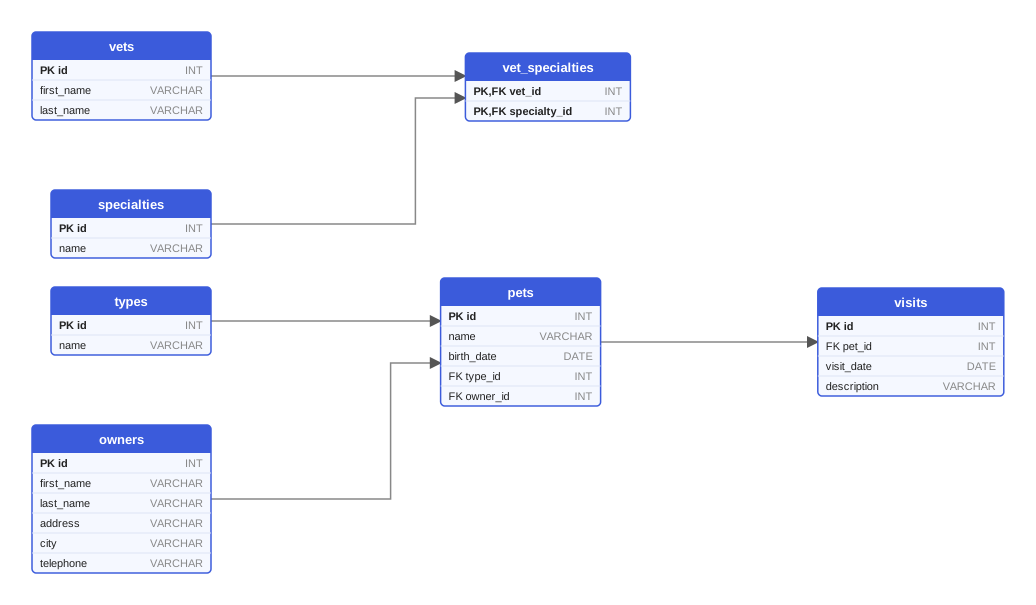
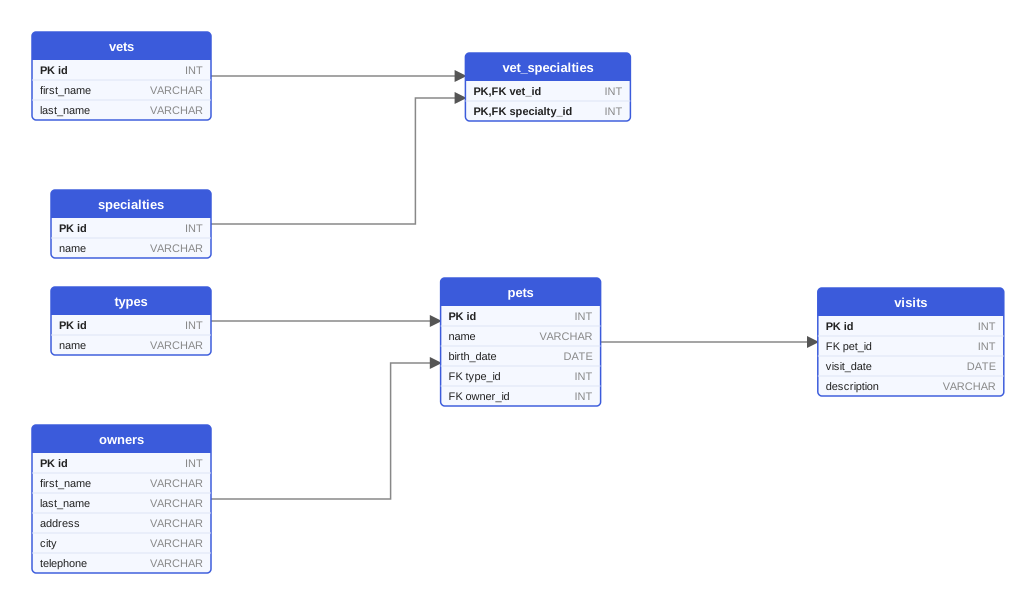
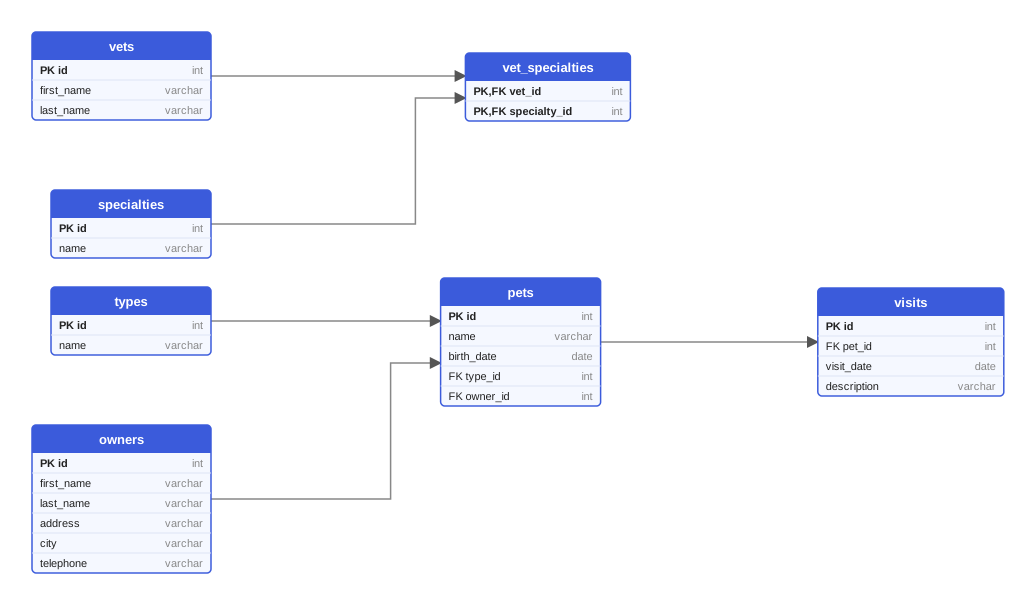
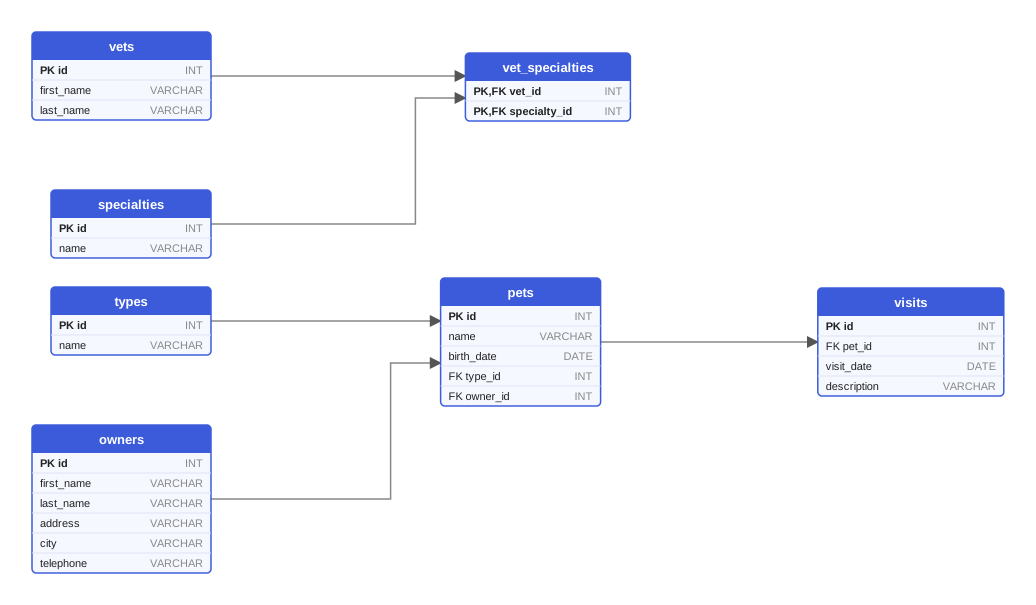
Identical Flyway files, six databases. The tables are the same; the type names are what each engine reports, and Oracle folds unquoted names to upper case.
An e-commerce schema, thirteen tables
Customers with addresses, a product catalog with a category tree, orders with items, payments, shipments and coupons, and product reviews. Four Flyway migrations on PostgreSQL 18.
CREATE TABLE customers
(
    id         BIGSERIAL PRIMARY KEY,
    email      VARCHAR(255) NOT NULL UNIQUE,
    first_name VARCHAR(100) NOT NULL,
    last_name  VARCHAR(100) NOT NULL,
    phone      VARCHAR(30),
    created_at TIMESTAMPTZ  NOT NULL DEFAULT now()
);

CREATE TABLE addresses
(
    id           BIGSERIAL PRIMARY KEY,
    customer_id  BIGINT       NOT NULL REFERENCES customers (id),
    line1        VARCHAR(255) NOT NULL,
    line2        VARCHAR(255),
    city         VARCHAR(100) NOT NULL,
    postal_code  VARCHAR(20)  NOT NULL,
    country_code CHAR(2)      NOT NULL,
    is_default   BOOLEAN      NOT NULL DEFAULT false
);
CREATE TABLE categories
(
    id        BIGSERIAL PRIMARY KEY,
    parent_id BIGINT REFERENCES categories (id),
    name      VARCHAR(120) NOT NULL,
    slug      VARCHAR(120) NOT NULL UNIQUE
);

CREATE TABLE products
(
    id          BIGSERIAL PRIMARY KEY,
    sku         VARCHAR(64)    NOT NULL UNIQUE,
    name        VARCHAR(255)   NOT NULL,
    description TEXT,
    price_cents INTEGER        NOT NULL,
    currency    CHAR(3)        NOT NULL DEFAULT 'EUR',
    weight_kg   NUMERIC(8, 3),
    is_active   BOOLEAN        NOT NULL DEFAULT true,
    created_at  TIMESTAMPTZ    NOT NULL DEFAULT now()
);

CREATE TABLE product_categories
(
    product_id  BIGINT NOT NULL REFERENCES products (id),
    category_id BIGINT NOT NULL REFERENCES categories (id),
    PRIMARY KEY (product_id, category_id)
);

CREATE TABLE inventory
(
    product_id BIGINT PRIMARY KEY REFERENCES products (id),
    quantity   INTEGER     NOT NULL DEFAULT 0,
    updated_at TIMESTAMPTZ NOT NULL DEFAULT now()
);
CREATE TABLE orders
(
    id                  BIGSERIAL PRIMARY KEY,
    customer_id         BIGINT      NOT NULL REFERENCES customers (id),
    shipping_address_id BIGINT      NOT NULL REFERENCES addresses (id),
    billing_address_id  BIGINT      NOT NULL REFERENCES addresses (id),
    status              VARCHAR(20) NOT NULL DEFAULT 'NEW',
    currency            CHAR(3)     NOT NULL,
    total_cents         INTEGER     NOT NULL,
    placed_at           TIMESTAMPTZ NOT NULL DEFAULT now()
);

CREATE TABLE order_items
(
    id               BIGSERIAL PRIMARY KEY,
    order_id         BIGINT  NOT NULL REFERENCES orders (id),
    product_id       BIGINT  NOT NULL REFERENCES products (id),
    quantity         INTEGER NOT NULL,
    unit_price_cents INTEGER NOT NULL
);

CREATE TABLE payments
(
    id           BIGSERIAL PRIMARY KEY,
    order_id     BIGINT      NOT NULL REFERENCES orders (id),
    provider     VARCHAR(40) NOT NULL,
    amount_cents INTEGER     NOT NULL,
    status       VARCHAR(20) NOT NULL,
    paid_at      TIMESTAMPTZ
);

CREATE TABLE shipments
(
    id              BIGSERIAL PRIMARY KEY,
    order_id        BIGINT      NOT NULL REFERENCES orders (id),
    carrier         VARCHAR(40) NOT NULL,
    tracking_number VARCHAR(64),
    shipped_at      TIMESTAMPTZ,
    delivered_at    TIMESTAMPTZ
);

CREATE TABLE coupons
(
    id          BIGSERIAL PRIMARY KEY,
    code        VARCHAR(32) NOT NULL UNIQUE,
    percent_off SMALLINT    NOT NULL,
    valid_from  DATE        NOT NULL,
    valid_to    DATE        NOT NULL
);

CREATE TABLE order_coupons
(
    order_id  BIGINT NOT NULL REFERENCES orders (id),
    coupon_id BIGINT NOT NULL REFERENCES coupons (id),
    PRIMARY KEY (order_id, coupon_id)
);
CREATE TABLE reviews
(
    id          BIGSERIAL PRIMARY KEY,
    product_id  BIGINT      NOT NULL REFERENCES products (id),
    customer_id BIGINT      NOT NULL REFERENCES customers (id),
    rating      SMALLINT    NOT NULL,
    body        TEXT,
    created_at  TIMESTAMPTZ NOT NULL DEFAULT now()
);
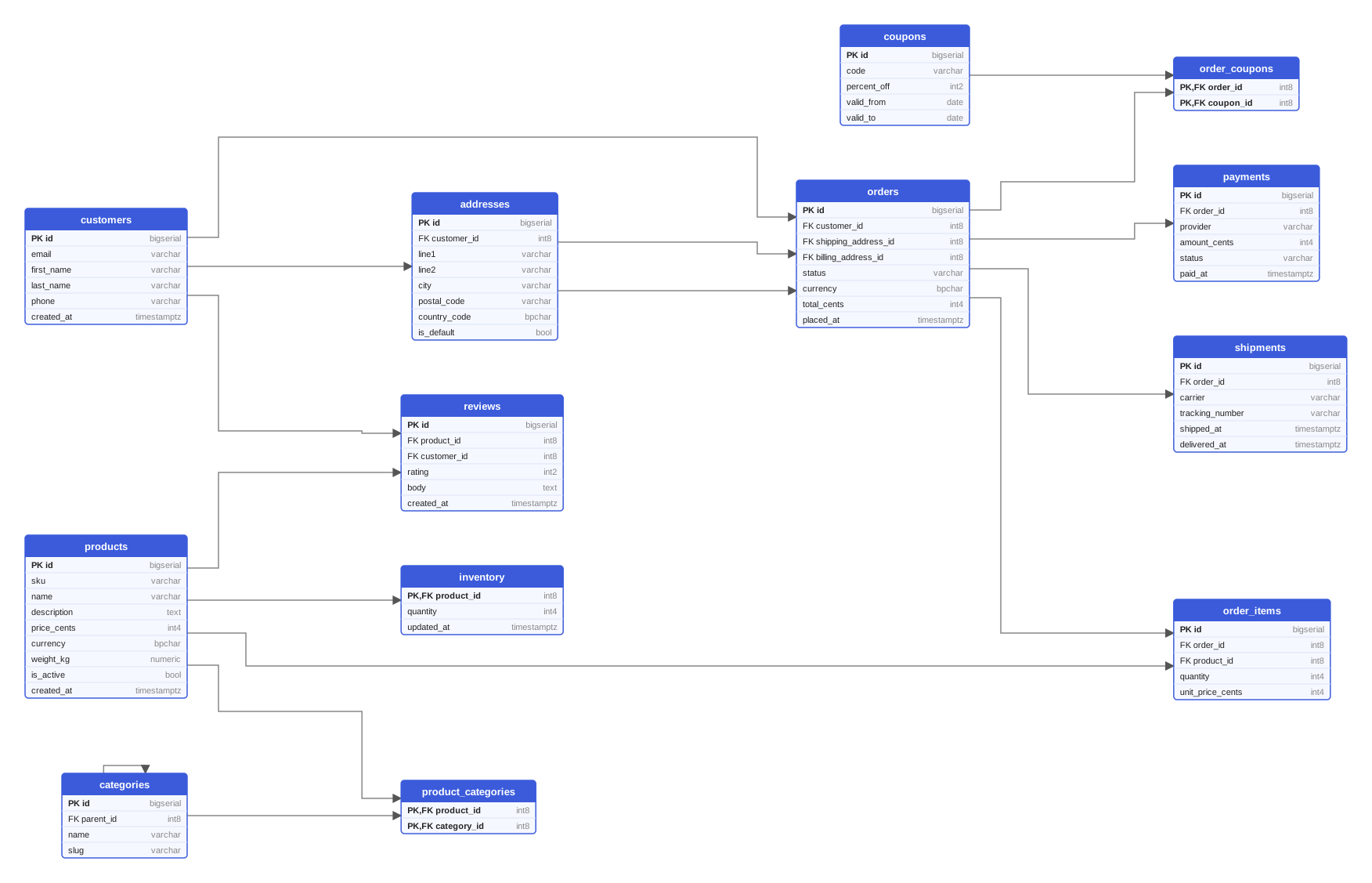
Scroll inside the frame, or open the SVG. Notice bigserial for identity columns, bpchar for CHAR(2), timestamptz, and the self-reference categories.parent_id.
When a migration is broken
A missing comma, the kind of typo that reaches production on a Friday. SchemaDrawer answers with the migration tool's own words.
V1__create_owners.sql
CREATE TABLE owners
(
    id         INT         NOT NULL,
    first_name VARCHAR(50) NOT NULL
    last_name  VARCHAR(50) NOT NULL,
    CONSTRAINT pk_owners PRIMARY KEY (id)
);
{
  "jobId": "7d2e9a10-4c6b-4f1e-9b3a-5e8d1c2f3a4b",
  "status": "ERROR",
  "createdAt": "2026-09-25T08:03:12Z",
  "errorMessage": "Flyway migration failed (exit code 1).\nOutput:\nFlyway OSS Edition 13.7.0 by Redgate\n...\nMigrating schema \"public\" to version \"1 - create owners\"\nErrors:\nERROR: Migration of schema \"public\" to version \"1 - create owners\" failed! Changes successfully rolled back.\nERROR: Failed to execute script V1__create_owners.sql\n----------------------------------------------\nSQL State  : 42601\nMessage    : ERROR: syntax error at or near \"last_name\"\n  Position: 100\nLocation   : /flyway/sql/V1__create_owners.sql\nLine       : 1",
  "diagramUrl": null
}
The same message Flyway prints locally, with the PostgreSQL error and position. The GitHub Action fails the workflow with it, which makes a broken migration visible in the pull request that introduces it.
Draw yours
Your migrations, your engine version, one SVG. Free while we build it.