Prisma Migrate Explained: migration.sql, Shadow Database and Drift
How Prisma Migrate works: the migrations folder layout, migrate dev versus migrate deploy, the shadow database, drift detection and baselining an existing database.
One timestamped directory per migration, each holding the migration.sql Prisma generated. SchemaDrawer runs Prisma 7.10.0 against a throw-away database of the engine you choose and returns an SVG of the schema it produces.
Upload the contents of prisma/migrations: one folder per migration, each holding the migration.sql Prisma generated. Keep the folder names, because Prisma orders migrations by them. migration_lock.toml may come along.
No Prisma schema is needed. SchemaDrawer writes a minimal schema.prisma with the datasource of the engine you chose; an uploaded schema.prisma is not used.
The sample below is the PetClinic schema written for Prisma Migrate, one of the sets SchemaDrawer's own tests draw on every engine:
prisma/migrations/
├── 20240101000001_create_owners_and_pets/
│   └── migration.sql
├── 20240101000002_create_vets/
│   └── migration.sql
└── 20240101000003_create_visits/
    └── migration.sql
The SQL inside migration.sql files.
prisma migrate deploy. The database is a fresh PostgreSQL, MySQL, MariaDB, SQL Server, Oracle or SQLite container in the version you ask for; nothing of yours is touched.
PostgreSQL 10, 11, 12, 13, 14, 15, 16, 17, 18 MySQL 8.0, 8.4, 9 MariaDB 10.6, 11.4, 11.8, 12 SQL Server 2017, 2019, 2022, 2025 Oracle SQLite
Not offered for Prisma Migrate: Oracle. The tool ships no driver for it, so nothing could run.
migrationType=PRISMAOwners, pets, types, vets, specialties and visits: the same seven tables every sample set on this site creates. These are the exact files the tests upload.
CREATE TABLE owners
(
    id         INT          NOT NULL,
    first_name VARCHAR(50)  NOT NULL,
    last_name  VARCHAR(50)  NOT NULL,
    address    VARCHAR(255),
    city       VARCHAR(80),
    telephone  VARCHAR(20),
    CONSTRAINT pk_owners PRIMARY KEY (id)
);

CREATE TABLE types
(
    id   INT         NOT NULL,
    name VARCHAR(80) NOT NULL,
    CONSTRAINT pk_types PRIMARY KEY (id)
);

CREATE TABLE pets
(
    id         INT         NOT NULL,
    name       VARCHAR(50) NOT NULL,
    birth_date DATE,
    type_id    INT         NOT NULL,
    owner_id   INT         NOT NULL,
    CONSTRAINT pk_pets PRIMARY KEY (id),
    CONSTRAINT fk_pets_types FOREIGN KEY (type_id) REFERENCES types (id),
    CONSTRAINT fk_pets_owners FOREIGN KEY (owner_id) REFERENCES owners (id)
);
CREATE TABLE vets
(
    id         INT         NOT NULL,
    first_name VARCHAR(50) NOT NULL,
    last_name  VARCHAR(50) NOT NULL,
    CONSTRAINT pk_vets PRIMARY KEY (id)
);

CREATE TABLE specialties
(
    id   INT         NOT NULL,
    name VARCHAR(80) NOT NULL,
    CONSTRAINT pk_specialties PRIMARY KEY (id)
);

CREATE TABLE vet_specialties
(
    vet_id       INT NOT NULL,
    specialty_id INT NOT NULL,
    CONSTRAINT pk_vet_specialties PRIMARY KEY (vet_id, specialty_id),
    CONSTRAINT fk_vet_specialties_vets FOREIGN KEY (vet_id) REFERENCES vets (id),
    CONSTRAINT fk_vet_specialties_specialties FOREIGN KEY (specialty_id) REFERENCES specialties (id)
);
CREATE TABLE visits
(
    id          INT NOT NULL,
    pet_id      INT NOT NULL,
    visit_date  DATE,
    description VARCHAR(255),
    CONSTRAINT pk_visits PRIMARY KEY (id),
    CONSTRAINT fk_visits_pets FOREIGN KEY (pet_id) REFERENCES pets (id)
);
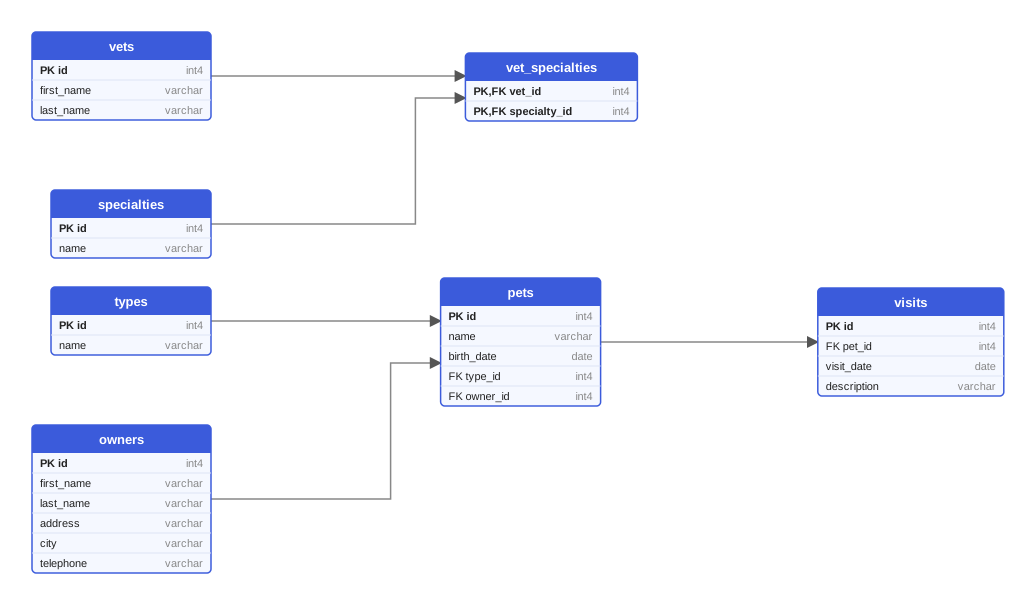
Every variant of the sample produces these seven tables. This diagram was drawn from the Flyway variant on PostgreSQL 18; on MySQL the types read INT and VARCHAR, on Oracle the names are upper case.
One multipart request queues the drawing; poll the job until it succeeds and download the SVG. Or let the GitHub Action do it and open a pull request with the diagram.
curl -X POST https://schemadrawer.com/api/v1/drawing \
  -H "Request-Id: $(uuidgen)" \
  -F "userId=5f0c1d2e-3a4b-4c5d-8e6f-7a8b9c0d1e2f" \
  -F "migrationType=PRISMA" \
  -F "databaseType=POSTGRESQL" \
  -F "version=18" \
  -F "files=@prisma/migrations/20240101000001_create_owners_and_pets/migration.sql;filename=20240101000001_create_owners_and_pets/migration.sql" \
  -F "files=@prisma/migrations/20240101000002_create_vets/migration.sql;filename=20240101000002_create_vets/migration.sql" \
  -F "files=@prisma/migrations/20240101000003_create_visits/migration.sql;filename=20240101000003_create_visits/migration.sql"
# {"jobId":"0b6e2f4c-8d1a-4c3e-9f7a-2a5b6c7d8e9f"}
Then poll GET https://schemadrawer.com/api/v1/drawing/{jobId} until status is SUCCESS and fetch diagramUrl. Details in the getting started guide and the API reference.
- uses: schemadrawercom/action@v1
  with:
    sql-directory: prisma/migrations
    output-path: docs/schema-diagram.svg
    migration-type: PRISMA
    database-type: POSTGRESQL
    database-version: '18'
    github-token: ${{ secrets.GITHUB_TOKEN }}
The action uploads the directory, waits for the diagram and opens a pull request with the SVG. See the action reference.
_prisma_migrations table is left out of the diagram.How Prisma Migrate works: the migrations folder layout, migrate dev versus migrate deploy, the shadow database, drift detection and baselining an existing database.
Editing applied migrations, environment-specific scripts, ORM auto-DDL in production, untested rollbacks: ten habits that break deployments, with a fix for each.
How Diesel manages a schema in Rust: the CLI, timestamped folders with up.sql and down.sql, the versions table, the generated schema.rs and embedded migrations.
Upload the migration directory, get an SVG back. Free while we build it.